Breakdown
Example of tyre size: 225/55 R 17 97 W
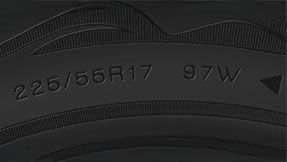
55: indicates the tyre series, meaning the ratio between the sidewall height and the tyre width. In this example, the sidewall height is 55% of the tyre width. The lower the ratio, the lower the sidewall height.
Note: a lower sidewall height can improve cornering grip, but it also results in a firmer ride.
R: refers to the internal construction of the tyre. R indicates that the construction is radial. Almost all tyres in use today are of radial construction, meaning the textile cords in the casing run from one bead to the other.
17: indicates the inner diameter of the tyre, in other words, the rim height. This measurement is expressed in inches. In this example, the diameter is 17 inches.
97: is the load index of the tyre. This index shows the maximum load the tyre can carry when inflated to its maximum safe pressure. In this example, it does not mean the tyre supports 97 kg — the number 97 corresponds to a reference value found in a load index table. For an index of 97, the maximum load is 730 kg per tyre.
W: corresponds to the speed rating of the tyre and indicates the maximum speed at which the tyre can safely carry a load. Speed ratings range from A (lowest) to Y (highest), with one exception: H falls between U and V. As with the load index, each letter corresponds to a specific speed rating in km/h:
C: 60 km/h
D: 65 km/h
E: 70 km/h
F: 80 km/h
G: 90 km/h
J: 100 km/h
K: 110 km/h
L: 120 km/h
M: 130 km/h
N: 140 km/h
P: 150 km/h
Q: 160 km/h
R: 170 km/h
S: 180 km/h
T: 190 km/h
U: 200 km/h
H: 210 km/h
V: 240 km/h
W: 270 km/h
Y: 300 km/h
ZR(Y): over 300 km/h
ZR: over 240 km/h
Reference Table: Load Index vs Load per Tyre in kg
Load Index | Load per Tyre (kg) | Load Index | Load per Tyre (kg) | Load Index | Load per Tyre (kg) |
|---|---|---|---|---|---|
70 | 335 | 87 | 545 | 104 | 900 |
71 | 345 | 88 | 560 | 105 | 925 |
72 | 355 | 89 | 580 | 106 | 950 |
73 | 365 | 90 | 600 | 107 | 975 |
74 | 375 | 91 | 615 | 108 | 1000 |
75 | 387 | 92 | 630 | 109 | 1030 |
76 | 400 | 93 | 650 | 110 | 1060 |
77 | 412 | 94 | 670 | 111 | 1090 |
78 | 425 | 95 | 690 | 112 | 1120 |
79 | 437 | 96 | 710 | 113 | 1150 |
80 | 450 | 97 | 730 | 114 | 1180 |
81 | 462 | 98 | 750 | 115 | 1215 |
82 | 475 | 99 | 775 | 116 | 1250 |
83 | 487 | 100 | 800 | 117 | 1285 |
84 | 500 | 101 | 825 | 118 | 1320 |
85 | 515 | 102 | 850 | 119 | 1360 |
86 | 530 | 103 | 875 | 120 | 1400 |
Other Markings
UTQG Code
The UTQG (Uniform Tire Quality Grading) standard is a North American regulation required by the U.S. Department of Transportation (FMVSS: Federal Motor Vehicle Safety Standards) for passenger car tyres.
Studded tyres (4x4 or off-road tyres), winter tyres, space-saver spare tyres, and tyres smaller than 12 inches are not covered by this standard.
This standard must appear on the sidewalls of tyres sold in the USA. Since almost all manufacturers operate in the American market, the UTQG marking is also found on the majority of tyres sold in Europe.
Manufacturing Information
These codes indicate when and where the tyre was manufactured. In this example:
DOT – Department of Transportation (USA)
BP – Code for the factory where the tyre was produced
M2 – Tyre size code
P711 – Optional code
4008 – Week and year of manufacture. In this case, week 40 of 2008.
Winter Markings
M+S
3PMSF
Tyres bearing this marking are designed for snowy road conditions and their performance is validated through testing.*
The three-peak mountain with snowflake symbol (3PMSF) on M+S (Mud & Snow) tyres identifies tyres intended for severe snow conditions.
*Winter braking performance test conducted according to ETRTO (European Tyre and Rim Technical Organisation) methods.
Warning: This “Safety Warning” marking is required in the USA.
- Tyre failure caused by under-inflation or overloading. Check the vehicle’s maintenance manual or the tyre placard (1).
- A blowout due to incorrect tyre/rim combination. Never exceed XX PSI (2) to seat the tyre beads on the rim. Only specially trained personnel should remove or fit tyres.
- Fitting radial and bias-ply tyres on the same vehicle, or fitting tyres of different sizes on the same axle.
(1) Tyre placard: required for vehicles in use in the USA, it describes the conditions of use for the tyres fitted to the vehicle.
(2) XX PSI (or YY kPa): manufacturer-specific value.